Repiping & Whole-Home Pipe Replacement in Lakewood, CA
Mass-tract repiping for Lakewood's galvanized and early-copper 1950s and 1960s housing stock. Call (562) 358-3931 for a free repipe assessment.
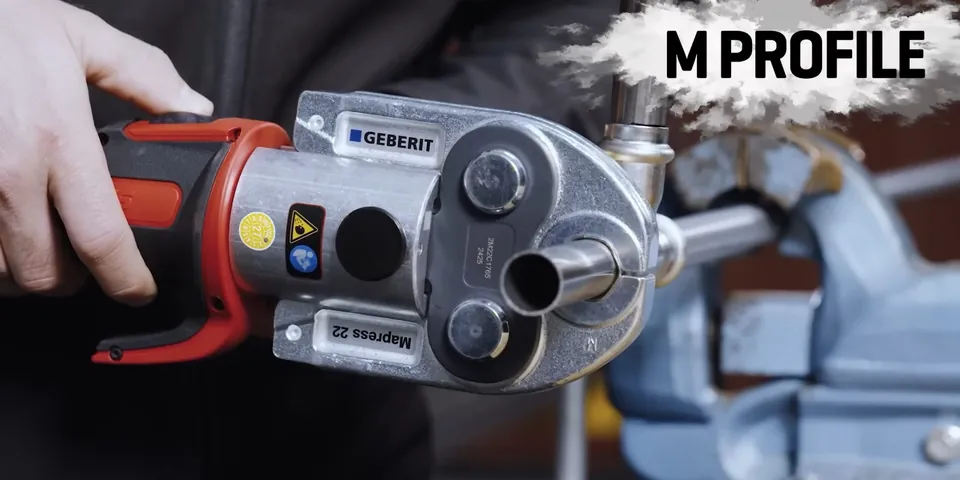
Press tool clamping a new pipe fitting provides a practical reference for the Repiping & Whole-Home Pipe Replacement in Lakewood, CA page.
Mass-Tract Repiping for Lakewood's 1950s and 1960s Homes
Repiping is the most definitive long-term plumbing investment available to a Lakewood homeowner with aging supply lines. The Lakewood Park Corporation's 1950 to 1965 build produced homes with supply systems that are now at or well past their expected service life: galvanized steel in the early builds corrodes from the inside and fails at fittings; early-era copper from the later 1950s and early 1960s is showing the pinhole failures that appear in the second half of that material's service life. Many Lakewood homes have mixed systems, with galvanized service laterals from the street and copper interior runs, or vice versa, sometimes with sections of CPVC or newer PEX from previous repairs. Repiping replaces all of that with a single consistent material on an above-slab route that bypasses the slab failures entirely.
We specialize in the specific configuration challenges of Lakewood's mass-tract construction: tight attic spaces in 7-foot-ceiling 1950s framing, slab-enclosed supply that must be bypassed rather than repaired in place, and service laterals that often require separate assessment from the interior supply system. A repipe assessment in a Lakewood home starts with identifying what pipe material is actually present at each section before recommending any approach.
Signs Your Lakewood Home Needs Repiping
Multiple Leaks at Different Locations
One leak in a galvanized supply line can be a spot repair. Two or more leaks at different fittings or pipe sections within a two-year period indicates system-wide deterioration. Galvanized steel corrodes from the inside out uniformly; if one section is failing, the rest of the pipe in the same vintage is typically at a similar stage. The same logic applies to pinhole failures in early copper.
Consistently Low Water Pressure
Interior corrosion of galvanized supply lines progressively narrows the pipe bore from the original diameter. A 3/4-inch galvanized line that has been in service for 70 years may have an effective bore of 1/4 inch or less from accumulated mineral deposits and corrosion buildup. If every fixture in the house has low pressure and no exterior cause is identified, the pipe interior is the likely source.
Rust-Colored or Discolored Water
Orange or brown water, particularly when the cold water tap is first opened after the house has been unoccupied, indicates iron oxide from corroding galvanized pipe entering the supply. This is more pronounced after any disturbance to the system such as a repair or a period of low usage. Water that runs clear after a few minutes is still carrying iron particles that gradually accumulate in fixtures and water heaters.
Recurring Pinhole Leaks in Copper
Pinhole failures in early-era copper supply are the copper equivalent of galvanized system-wide deterioration. A pinhole leak at one location in a 60-year-old copper run indicates that the pipe wall is at a corrosion stage where additional pinholes will appear at other locations over the following months to years. Continued spot repairs become increasingly expensive relative to the cost of repiping the system.
Repeated Slab Repairs at the Same Address
If your Lakewood home has had two or more slab leak repairs at different locations, the underlying pipe system is in late-stage deterioration. Each additional spot repair adds cost without addressing the rest of the aging pipe. At that point, a complete repipe that replaces all supply and routes it above the slab is almost always more cost-effective over a five-year horizon than continued individual repairs.
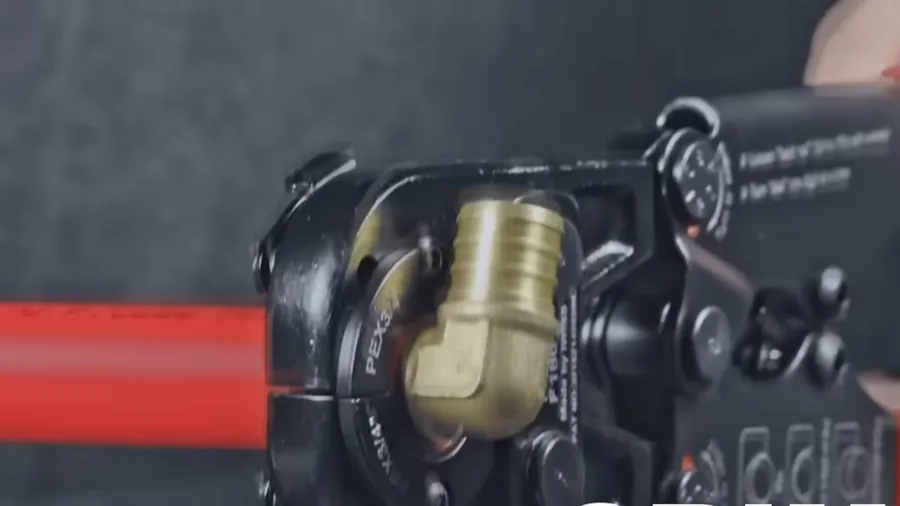
This detail highlights red PEX pipe being crimped with a specialty tool, a key part of the work described for Repiping & Whole-Home Pipe Replacement in Lakewood, CA.
Repipe Options for Lakewood's Mass-Tract Homes
The most common repipe approach for Lakewood's 1950s slab-on-grade construction is a full PEX repipe routed through the attic. New PEX supply lines are run from a central manifold located in the attic or a utility space, down through interior walls to each fixture location. This approach avoids the slab entirely and delivers a complete, modern supply system with individual shutoffs at each fixture group. The attic in Lakewood's original construction is typically a 7-foot crawlspace accessible through a ceiling hatch, which requires specific routing techniques different from newer two-story homes.
For homes where full repiping is not yet necessary but specific slab sections have failed, a targeted slab reroute bypasses only the failed section using a shorter attic or wall run. For service laterals from the city main to the house that are galvanized, the lateral replacement is typically handled separately from the interior repipe and requires coordination with the City of Lakewood's utility connection requirements.
Repiping Cost in Lakewood, CA
A whole-home repipe for a standard 3-bedroom, 1-bathroom to 2-bathroom Lakewood tract home typically costs $7,000 to $12,000 for PEX using an attic routing approach. Homes with larger footprints, additional bathrooms added after original construction, or complex routing requirements due to prior partial repairs run $10,000 to $18,000. These ranges assume the service lateral from the street is in acceptable condition and does not require replacement; lateral replacement is typically an additional $3,500 to $7,000 depending on depth and run length to the street main.
We provide written repipe estimates itemized by scope: interior supply, service lateral, permit fees, drywall patching allowance, and any fixture reconnections required. There are no unexpected charges after work begins on items covered in the written estimate.
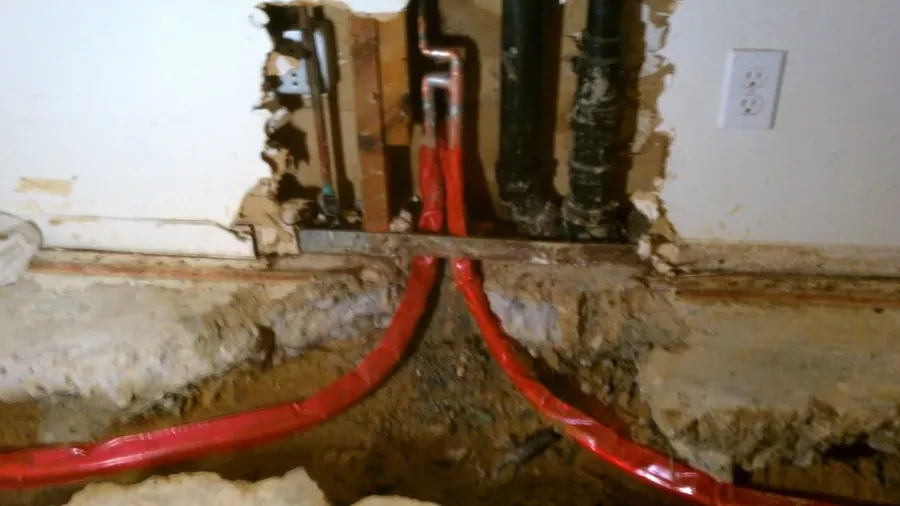
The photo focuses on new red and blue PEX lines routed through an open wall so the Repiping & Whole-Home Pipe Replacement in Lakewood, CA process is easier to understand.
Frequently Asked Questions: Repiping in Lakewood
How long does a full repipe take in a Lakewood, CA tract home?
A standard 3-bedroom, 2-bathroom Lakewood tract home takes 2 to 4 days for the pipe replacement work: one to two days for rough-in (running new pipe through the attic, walls, and connecting to fixtures) and one additional day for final connections, pressure testing, and patch work. Drywall patching is typically a separate step that follows after the plumbing inspection is completed.
What pipe material is best for repiping a 1950s Lakewood home?
PEX (cross-linked polyethylene) is the most common choice for whole-home repiping in Lakewood's mass-tract stock. It is flexible enough to route through attic spaces and existing framing without the number of fittings required by copper or CPVC. It does not corrode, is resistant to freeze damage, and is compatible with Lakewood's Central Groundwater Basin water chemistry. Copper is an alternative for those who prefer a metal supply system, but costs more and requires more labor in the tight attic spaces of Lakewood's original tract construction.
Do I need to move out during repiping of my Lakewood home?
Most homeowners stay in the house during repiping. Water is shut off each day for the active work period, typically 8 AM to 4 PM, and restored each evening before the crew leaves. For the first day or two when most of the water is off, having a plan for showering at a gym or family member's home makes the process more comfortable, but it is not required. We coordinate the daily shutoff schedule with you in advance.
Does repiping a house in Lakewood require a permit?
Yes. A whole-home repipe in Lakewood, CA requires a plumbing permit from the City of Lakewood Building and Safety Division. We handle the permit application as part of the project. An inspection is required after rough-in and before walls are closed. The permit process adds several days to the project timeline but protects you at resale and ensures the work meets California Plumbing Code.