Acoustic, thermal, and electronic detection for supply line failures under Lakewood's slab-on-grade foundations. Call (562) 358-3931 for slab leak service.
Slab leak pipe access exposed beside a foundation provides a practical reference for the Slab Leak Detection & Repair in Lakewood, CA page.
Slab Leaks in Lakewood's Post-WWII Construction
Every home built by the Lakewood Park Corporation between 1950 and the mid-1960s is a slab-on-grade structure. That construction method, efficient for the production pace of the time, placed all supply lines running under the living space in direct contact with the concrete slab and the alluvial soil below it. After seven decades, the galvanized and early-copper pipes that run through those slabs are at or past their expected service life at the slab interface. The groundwater chemistry of Lakewood's Central Groundwater Basin deep-well supply adds an additional corrosion factor at the buried pipe-to-soil boundary.
The result is a slab leak rate in Lakewood's housing stock that makes detection and repair one of our most common service categories. Homes on Faculty Avenue, along the Carson Street corridor, in the Lakewood Village neighborhood, and throughout the Del Amo Boulevard grid are all in the same age window where slab failures are predictable and widespread. We detect and repair slab leaks in Lakewood and the adjacent SE LA Gateway Cities, using acoustic, thermal, and electronic methods to locate failures before any concrete is opened.
Warning Signs of a Slab Leak in Your Lakewood Home
Warm or Hot Spots on the Floor
A warm patch on a tile or concrete floor that does not correspond to any radiant heating or heating duct is one of the most reliable signs of a hot water supply line leak under the slab. In Lakewood's slab-on-grade homes, hot water lines and cold water lines often run parallel, so a warm spot can indicate either. The affected area tends to grow over time as the leak volume increases.
Higher-Than-Expected Water Bills
A slab leak that runs continuously without being visible can lose hundreds of gallons per day. If your water bill has increased without a corresponding change in usage — no additional occupants, no new irrigation, no swimming pool filling — and the increase is consistent across two or more billing cycles, a slab leak is one of the first possibilities to rule out. Compare your bill to the same month in the prior year if possible.
The Sound of Running Water
A faint hissing or rushing sound audible near the floor or from within the slab structure, with all interior and exterior fixtures turned off, indicates an active pressurized leak under or within the slab. This is more audible near the slab perimeter and in quieter rooms. In Lakewood's original construction, supply lines are typically closest to the perimeter of the slab near exterior walls.
Moving Water Meter With All Fixtures Off
Close all interior and exterior water outlets completely, then observe the meter dial for 15 minutes without using any water. If the dial is moving, there is an active leak somewhere in the supply system. This test confirms the leak is on the pressure side of the system rather than a drain or sewer issue. Combined with no visible exterior leak, a moving meter strongly indicates a slab leak or a supply line failure inside a wall.
Cracks in Tile or Slab Surface
A slow slab leak that saturates the soil below the concrete can cause differential settlement. This sometimes manifests as new cracks in flooring tile, grout, or even the concrete slab surface itself. Hairline cracks in new tile in a Lakewood home that had no previous tile cracks should be investigated for slab moisture, especially if other warning signs are present.
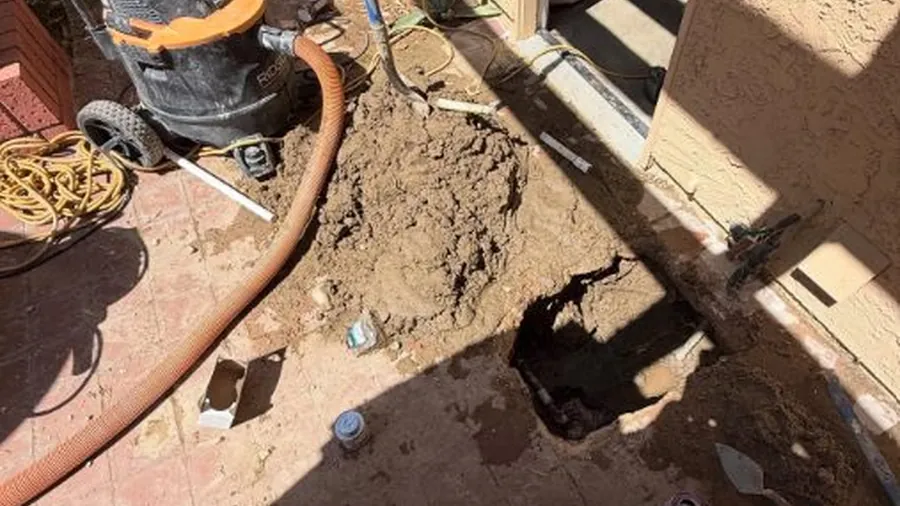
This detail highlights slab access hole with repair tools nearby, a key part of the work described for Slab Leak Detection & Repair in Lakewood, CA.
How We Detect Slab Leaks in Lakewood Homes
Lakewood's 1950s construction requires multiple detection methods because the pipe type, depth, and slab thickness vary depending on the build year and any subsequent repairs. We begin with acoustic listening devices that amplify the sound of pressurized water escaping through a pipe wall or fitting. For most Lakewood slab leaks, acoustic detection narrows the location to within one to two feet. For cases where acoustic methods are inconclusive, thermal imaging cameras detect the temperature differential between a leaking hot water line and the surrounding slab surface. Electronic correlators and tracer gas methods are available for cases where both primary methods produce ambiguous results.
We locate the failure point before recommending a repair approach. Opening the slab without confirmation of the exact leak location wastes concrete and increases the area of disturbance in your flooring. Our goal is the smallest possible slab opening consistent with a complete, lasting repair.
Slab Leak Repair Options for Lakewood's Housing Stock
After locating the leak, we present three repair options depending on the pipe condition and your home's overall plumbing profile. A spot repair opens the slab at the confirmed failure location, replaces the affected pipe section, and restores the concrete. This is appropriate when the failure is isolated and the rest of the pipe system is in good condition. Spot repair cost typically ranges from $1,500 to $4,500 depending on the depth and location of the pipe and the flooring above it.
If the pipe system has had previous slab repairs, or if inspection shows the surrounding pipe is in poor condition, a slab reroute runs a new pipe through the attic or walls to bypass the entire failed slab section. This is often more cost-effective than repeated spot repairs. For homes with widespread pipe deterioration throughout the slab system, a full whole-home repipe using an above-slab route is the definitive long-term solution.
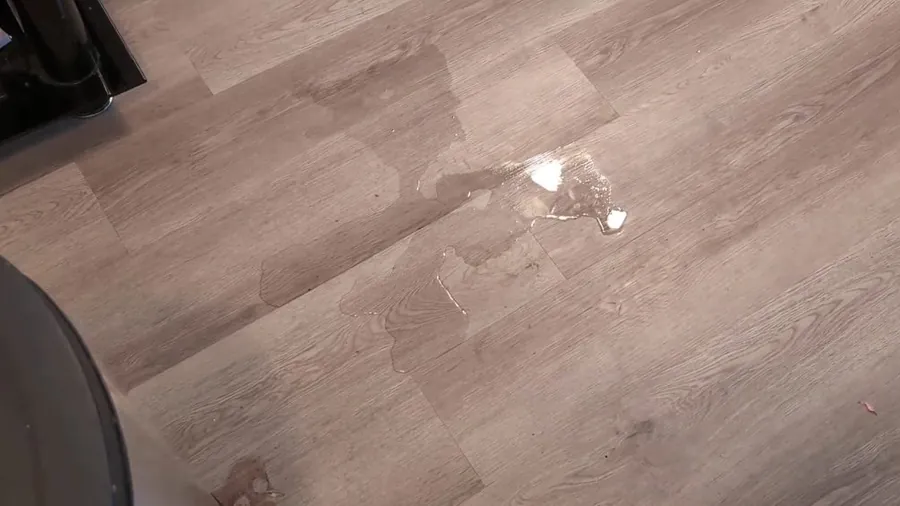
The photo focuses on water puddle on a finished floor from a slab leak so the Slab Leak Detection & Repair in Lakewood, CA process is easier to understand.
Frequently Asked Questions: Slab Leaks in Lakewood
How do I know if I have a slab leak in my Lakewood home?
The most common signs are: a warm or hot spot on the floor that doesn't correspond to any radiant heating; a higher-than-normal water bill without any change in usage; the sound of running water or a hissing noise with all fixtures turned off; and visible cracks in tile or other hard flooring. If your water meter continues to move with all interior and exterior valves closed, that confirms an active leak somewhere in the supply system.
What does slab leak detection cost in Lakewood, CA?
Detection typically costs $200 to $450 depending on the method required and the size of the slab area to be assessed. Acoustic detection is the starting point for most Lakewood homes. Thermal imaging and electronic detection are added when acoustic methods do not pinpoint the location. The detection cost is separate from the repair cost and is credited toward the repair if you proceed with us.
Is a slab leak covered by homeowners insurance in California?
This depends on your policy and the cause of the leak. Most standard California homeowners policies cover sudden and accidental water damage from a slab leak, but exclude damage from gradual leaks or from corrosion that was not sudden. Coverage for the cost of accessing the pipe (breaking the concrete) is a separate line item in some policies. Review your policy's water damage and earth movement exclusions and contact your insurer before work begins if you plan to make a claim.
What are the repair options for a slab leak in a 1950s Lakewood home?
There are three standard approaches: (1) spot repair, where the slab is opened at the leak location and the pipe is patched or spliced; (2) pipe rerouting, where a new pipe is run through the attic or walls to bypass the failed slab section entirely; and (3) full repipe, where all supply lines are replaced using an above-slab path. The right approach depends on the overall condition of the rest of the pipe system, the number of previous slab repairs, and the pipe material involved.