Licensed & Insured · 24/7 Emergency Plumber · Serving Lakewood & SE LA Call (562) 358-3931

What Type of Pipes Are in Most Lakewood, CA Homes?

The answer depends almost entirely on when your home was built. Lakewood's post-WWII mass-construction era produced a city full of aging pipe that most homeowners have never seen or thought about until something goes wrong.

Old cast iron drain pipe with corrosion and scaling for What Type of Pipes Are in Most Lakewood, CA Homes?
A close look at old cast iron drain pipe with corrosion and scaling shows why careful diagnosis matters for What Type of Pipes Are in Most Lakewood, CA Homes?.

The Answer Depends on When Your Home Was Built

Lakewood is an unusual city for plumbing purposes. Between 1950 and 1965, the Lakewood Park Corporation built most of the city's residential housing stock in a single mass-construction effort. This concentrated build window means the pipe materials used in any given Lakewood home depend almost entirely on the year that home was completed, because the residential construction industry made a clear material shift from galvanized steel to copper supply during the exact years Lakewood was being built.

If your Lakewood home was completed between 1950 and approximately 1957, it almost certainly has galvanized steel supply pipe throughout, both the service lateral from the street and the interior supply distribution. If it was completed between 1958 and the mid-1960s, it likely has early-era copper in the interior supply runs, possibly with galvanized still in the service lateral from the street. If it has been repiped at any point since the 1980s, it may have copper, CPVC, or PEX in at least some sections depending on when and what the repipe used. The simplest way to know for certain is to have a plumber assess the pipe material at your meter, at the water heater, and at accessible points under sinks and in any crawlspace or attic access.

Galvanized Steel Supply in Lakewood’s 1950–1957 Homes

What Galvanized Pipe Looks Like

Galvanized steel supply pipe is iron pipe that was coated with a zinc layer to slow corrosion. In its original state it looks silver-gray. After 65 to 75 years in use, the exterior of galvanized pipe in Lakewood homes typically looks rust-orange or dark brown at fitting connections, and the interior is lined with iron oxide deposits that have progressively narrowed the bore. If you look at the pipe at your water meter entry or at an accessible section under a sink in a 1950s Lakewood home and see rust-orange threaded fittings with gray or orange pipe, you have galvanized steel supply.

Why Galvanized Was Used in 1950s Lakewood

Galvanized steel was the residential supply standard in the late 1940s and early 1950s. It was inexpensive, widely available, and well understood by contractors and plumbing suppliers at the time. The Lakewood Park Corporation built homes at an extraordinary pace (reportedly completing one home every seven and a half minutes at peak production), and galvanized supply was the logical choice for that production environment. The design life expectation at the time was approximately 40 to 50 years, meaning galvanized supply in a 1952 Lakewood home was always expected to need replacement by the 1990s or 2000s.

What 65-to-75-Year-Old Galvanized Looks Like Now

Galvanized supply at 65 to 75 years in Lakewood's hard Central Groundwater Basin water has almost universally reached the advanced corrosion stage. Interior rust and calcium oxide deposits have reduced the pipe bore to a fraction of its original diameter in most properties. The visible results are low water pressure throughout the house, rust-tinted water after the supply has been undisturbed overnight, and recurring failures at threaded fittings that need repair every year or two. If you have galvanized supply and recognize these symptoms, your system is past cost-effective spot repair territory. A whole-home repipe assessment is the appropriate next step.

Early Copper Supply in Lakewood’s 1958–1965 Homes

The Transition to Copper in Lakewood

Copper replaced galvanized as the standard residential supply material in California during the late 1950s. In Lakewood, homes built from approximately 1958 onward received copper interior supply in most cases. The transition was gradual and not uniform across all contractors, so some 1957 builds have copper and some 1959 builds still have galvanized sections, but the general pattern holds: late 1950s Lakewood homes switched to copper.

Copper supply installed in 1958 to 1965 is now 60 to 67 years old. That is a significant age for copper, and it places these Lakewood homes in the mid-to-late stage of the expected copper service life. Early-era copper from this period was pure copper tubing of standard wall thickness. At 60-plus years of age, copper wall thinning from the combination of Lakewood's hard water chemistry and thermal cycling at slab-contact zones produces the slab leaks that are increasingly common in this section of Lakewood's housing stock.

Mixed Systems: Galvanized Lateral, Copper Interior

A significant portion of Lakewood homes have a mixed system: a galvanized steel service lateral from the street (the pipe that runs from the city water main to the house) combined with early copper supply inside the house. This configuration was common in the late 1950s and early 1960s when contractors were transitioning to copper for interior work but the service lateral from the street was still being installed in galvanized.

Mixed systems have a specific failure profile: the galvanized lateral corrodes and restricts pressure from the entry point, and the junction where galvanized and copper meet inside or at the slab penetration is a particularly high-failure location due to the electrolytic interaction between the two different metals. If you have had a slab leak near the house water meter entry, it may be at this galvanized-copper interface. We identify the exact pipe material at each section during any supply assessment in Lakewood homes.

PEX, CPVC, and Later Pipe Materials in Lakewood Homes

If your Lakewood home has been repiped at any point after approximately 1985, it may have PEX (cross-linked polyethylene), CPVC (chlorinated PVC), or later-era copper in at least some sections. PEX is the material most commonly used in whole-home repipes today: it is flexible, which allows rerouting through attic space without needing to access the slab for most of the supply runs, it does not corrode, and it handles Lakewood's hard well water without the calcium deposit formation that can affect faucet aerators and water heaters supplied by standard CPVC or older copper. CPVC was commonly used in repairs and repipes from the 1980s through the 2000s and is now showing its own age-related failure mode in some Lakewood properties: brittleness and fitting failures in pipe sections that have experienced prolonged UV exposure or thermal cycling.

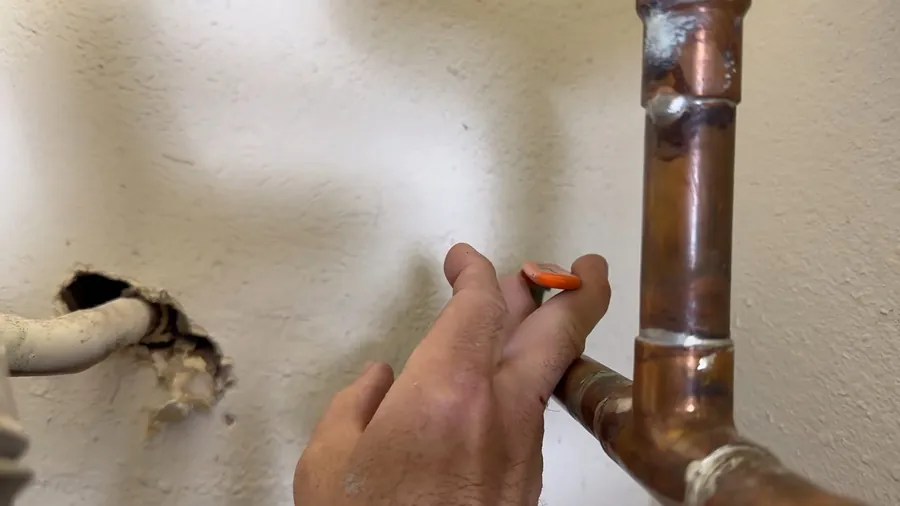
If you are unsure whether your home has been previously repiped in any section, the visible pipe at accessible points is the most reliable check. Cream or off-white colored pipe is CPVC. Gray, silver, or dark-colored flexible pipe is PEX. Copper pipe is orange-pink in color where the exterior is undamaged. Orange-brown or gray threaded pipe is galvanized.

Copper pipe access opening at a wall repair for What Type of Pipes Are in Most Lakewood, CA Homes?
Copper pipe access opening at a wall repair provides a practical reference for the What Type of Pipes Are in Most Lakewood, CA Homes? page.

How to Check Which Pipes Are in Your Lakewood Home

The easiest first check is your water meter entry point. Look at the pipe coming out of the ground near the meter: threaded gray or orange pipe with rust at the fittings is galvanized; smooth orange-pink pipe with soldered or compression fittings is copper. Check the same material under a bathroom sink where the supply stop valves connect to the wall supply stub-out. These two points tell you the material of the service lateral and the interior distribution respectively.

For a comprehensive assessment, a licensed plumber can check the material throughout the supply system, including the sections under the slab where the most critical failure conditions develop in Lakewood's 1950s and early 1960s housing stock. We provide free pipe material assessments as part of any service call or at a scheduled assessment visit throughout our Lakewood and SE LA service area.

What to Do if You Have Galvanized or Aging Copper

If your Lakewood home has galvanized supply and is showing the signs of system-wide deterioration (low pressure, rust-tinted water, recurring fittings), a repipe assessment is the appropriate step. We provide written estimates for both continued spot repair and whole-home repiping, with a five-year cost comparison so you can make an informed financial decision about the most cost-effective approach for your specific situation.

If your home has early copper from the late 1950s or 1960s and you are seeing warm floor spots, elevated water bills, or hearing running water with all fixtures off, a slab leak assessment is the appropriate first step. We use acoustic and thermal detection to locate failures before any concrete is opened. Call (562) 358-3931 for a pipe assessment or any plumbing service in Lakewood or the surrounding SE LA cities.

Find Out What Pipes Are in Your Lakewood Home

Free pipe material assessments with any service call. Serving Lakewood and SE LA, 24/7.

Call (562) 358-3931