
Lakewood CA Water Quality: Hard Well Water and What It Does to Your Plumbing
Lakewood is one of the few cities in the Los Angeles basin that receives no imported Metropolitan Water District supply. All of Lakewood’s water comes from deep groundwater wells, and that fact has direct consequences for every plumbing system in the city.

Where Lakewood’s Water Comes From
The City of Lakewood's water system draws exclusively from the Central Groundwater Basin, a major groundwater aquifer underlying much of the Los Angeles coastal plain. The Central Basin is one of the most productive groundwater basins in California, with deep wells that access water that has percolated through the natural geology over extended periods. Unlike many surrounding cities that blend Central Basin groundwater with imported water from the Metropolitan Water District (MWD), Lakewood uses no imported surface water at all. Every drop of water that comes out of a Lakewood faucet has come up from underground wells.
This is worth understanding because it is the source of a specific water chemistry profile that affects plumbing in Lakewood differently than in MWD-blend cities. MWD imported water is relatively soft by the time it reaches distribution, having been treated to reduce mineral content and mixed with water from multiple sources. Central Basin groundwater is naturally hard, carrying the dissolved minerals that have accumulated in the groundwater as it percolated through the mineral-rich geology. Lakewood homeowners are using water that is meaningfully harder and higher in total dissolved solids than most of their neighbors in adjacent cities with MWD blends.
The Numbers: Lakewood’s Hard Water Profile
Lakewood's well water typically has a total hardness above 300 parts per million (ppm) as calcium carbonate, which falls in the "very hard" category by standard water hardness classifications. Total dissolved solids (TDS) in Lakewood's supply are correspondingly elevated above what most residential water treatment equipment considers optimal. The water is alkaline, with a pH that varies by well and season but generally falls in the mildly alkaline range above neutral 7.0. The specific mineral breakdown includes calcium and magnesium as the primary hardness contributors, with sodium, potassium, sulfate, and chloride also present at meaningful concentrations.
For context, the US Geological Survey classification of "very hard" water begins at 180 ppm total hardness. Lakewood's supply regularly tests above 300 ppm. This places Lakewood's water in the category where mineral scale accumulation on fixtures, in water heaters, and at pipe wall surfaces is a predictable and ongoing maintenance concern rather than an occasional inconvenience.
What Hard Well Water Does to Your Pipes
Effect on Galvanized Supply
In galvanized steel supply pipe, Lakewood's hard well water accelerates the interior iron oxide corrosion process in two ways. First, the higher mineral content in the water increases the electrolytic activity between the water and the exposed iron pipe wall once the zinc coating is depleted, which accelerates the rate at which iron oxide (rust) forms and adheres to the interior wall. Second, calcium and magnesium minerals in the water contribute to the mineral deposit layer that builds up alongside the rust, further narrowing the pipe bore. This combination of iron oxide and mineral scale accumulation in Lakewood's galvanized pipe is why bore restriction and pressure loss often appear earlier in Lakewood galvanized homes than the nominal pipe age would predict based on galvanized performance in softer water environments.
The practical result is that galvanized pipe in Lakewood reaches the end-of-life pressure loss stage at approximately 60 to 65 years rather than the 70 to 80 years that galvanized pipe in softer-water environments can achieve. This means the oldest galvanized in Lakewood (from the 1950 to 1953 builds at 72 to 75 years) has been in the end-of-life category for 10 to 15 years already, and even the mid-range galvanized from the 1955 to 1957 builds has entered or is approaching the advanced corrosion stage.
Effect on Copper Supply
In copper supply pipe, Lakewood's hard water contributes to two different failure mechanisms. The first is calcium carbonate scale formation at pinhole sites. When a copper pipe develops a micro-pit at the surface from corrosion, calcium carbonate from the hard water precipitates at the pit, forming a visible white deposit. This calcium scale at pit locations is sometimes mistaken for a benign mineral deposit, but it is actually a marker for underlying pipe wall thinning at the same location. The second mechanism is more direct: the higher TDS in Lakewood's groundwater increases the electrolytic conductivity of the water, which slightly accelerates the electrochemical corrosion of copper pipe walls compared to lower-TDS soft water.
For early copper in Lakewood homes from the late 1950s and early 1960s, the combination of pipe age (60 to 67 years), slab-contact exposure, and hard water chemistry produces a higher-than-average slab leak rate compared to similarly aged copper in softer-water cities. Lakewood plumbers who work primarily in this city see more copper slab leaks per year per capita than would be expected from the pipe age alone.
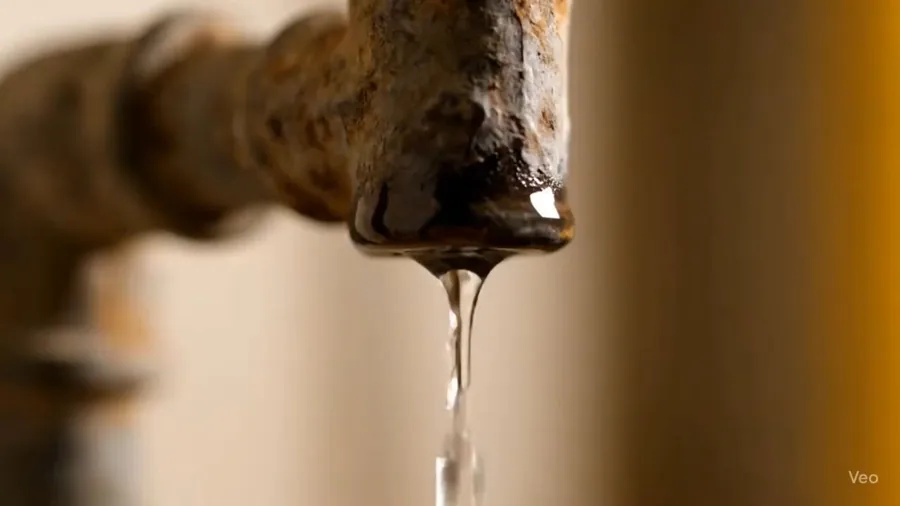
What Hard Water Does to Water Heaters in Lakewood
Water heater sediment accumulation is one of the most visible and directly measurable effects of Lakewood's hard well water on household plumbing. When hot water is produced in a tank water heater, dissolved calcium and magnesium minerals precipitate out of solution as calcium carbonate and magnesium hydroxide and settle to the bottom of the tank as a chalky or gritty sediment layer. In soft-water environments, this sediment accumulation is relatively slow. In Lakewood's hard well water environment, the sediment accumulation rate is significantly higher, and the standard 10 to 15 year tank water heater life in Lakewood should be understood as a conservative upper limit rather than an expected minimum.
The signs of significant sediment accumulation in a Lakewood water heater include popping or rumbling sounds during heating cycles (the sound of water boiling under or through the sediment layer), reduced hot water capacity or recovery rate, and the appearance of white or gray gritty material at hot water taps. Flushing the water heater annually reduces sediment accumulation and extends tank life. We perform water heater flush, maintenance, and replacement throughout Lakewood and the surrounding SE LA service area.
Water Softeners and Filtration for Lakewood Homes
A whole-home water softener is the most direct solution to Lakewood's hard water conditions. Ion-exchange water softeners replace the calcium and magnesium ions in the water supply with sodium ions, producing water with dramatically reduced hardness that does not form scale on fixtures, does not accelerate pipe wall corrosion to the same degree, and produces a noticeably different shower and dish-washing experience. Water softeners do require periodic regeneration (recharging the ion-exchange resin with salt) and produce a small volume of brine wastewater during each regeneration cycle.
For homeowners who want to address specific water quality concerns beyond hardness, whole-home water filtration systems can be added to address specific TDS components or to produce drinking water quality throughout the house. Reverse osmosis systems at the kitchen tap are also commonly used in Lakewood homes to produce low-TDS drinking and cooking water from the hard well supply. We install, service, and maintain water softeners and filtration systems throughout Lakewood and the surrounding SE LA area. Call (562) 358-3931 for water quality service in Lakewood or a free assessment of the softening and filtration options appropriate for your home and water use profile.
Address Hard Water in Your Lakewood Home
Water softener installation, whole-home filtration, water heater service. Serving Lakewood and SE LA, 24/7.
Call (562) 358-3931